
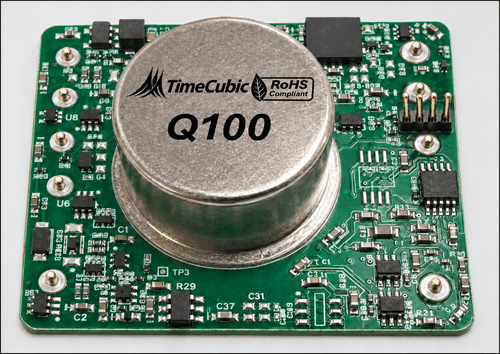
Mechanical Outline
39.1 × 34.0 × 13.7 mmStandard 8-Pin Form Factor (1.54 × 1.34 × 0.54 in)
Hermetically sealed metal enclosure • Pin through-hole mounting for subsea nodes
Measured 60-Day Holdover
±1.0 ms / 60d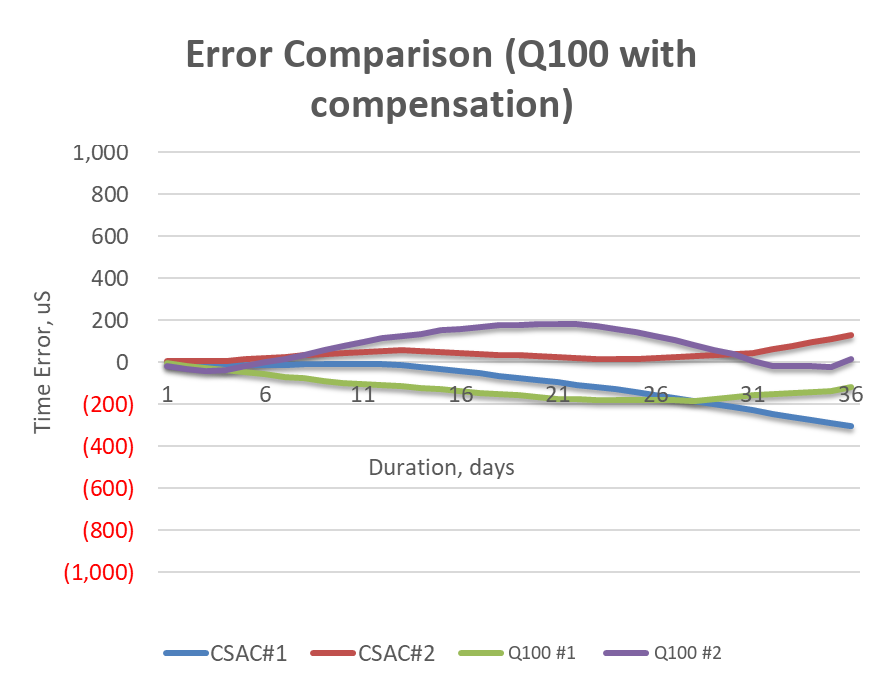
Empirical Subsea Blind Drift vs. Chip-Scale Atomic Clock (CSAC)
Core Architectural Highlights
Enables high-precision synchronized timing in Ocean Bottom Nodes (OBN), subsea seismic arrays, and mobile defense units without requiring heavy battery packs.
Synchronizes to external GNSS or atomic reference clocks prior to deployment, disciplining to 1 ns RMS phase error and <1×10-12 in frequency, with ±1.0 ms holdover across 60+ days.
Built-in phase detection engine measures and reports real-time drift with ≤1 nanosecond resolution over an integrated RS232 digital serial port for seabed nodes and tactical systems on the move.
Technical Specifications (Rev O Standard)
| Supply Voltage | +3.3V DC (±5%) |
| Steady-State Power | 65 mW typ (<75 mW max @ 25°C) |
| Warm-Up Power & Time | 220 mW (1 min typ to locked holdover) |
| Standard Frequencies | 10 MHz standard (5, 8.192, 16.384 MHz available) |
| Output Waveform | HCMOS (VOH ≥2.4V, VOL ≤0.4V, 50Ω load) |
| 1PPS Synchronization | 1 ns RMS Phase Error • <1×10-12 Frequency |
| Subsea Blind Holdover | ±1.0 ms / 60 days (constant temp, mathematical model) |
| Aging Rate (Free-Run) | ±0.07 ppb/day typ (±0.5 ppb/day max) |
| Operating Temperature | -10°C to +50°C (Extended -40°C to +85°C available) |
| Digital Communications | RS232 (57600 baud, 8-N-1) • 1-sec continuous phase report |
| Package Dimensions | 39.1 × 34.0 × 13.7 mm (1.54 × 1.34 × 0.54 in) |
Pin Configuration
| Pin # | Signal | Description |
|---|---|---|
| 1 | VDD | +3.3V DC Power Input |
| 2 | 1PPS_IN | 1PPS Reference Input for Disciplining |
| 3 | 1PPS_OUT | Synchronized 1PPS Pulse Output |
| 4 | RF_OUT | 10 MHz HCMOS Clock Output |
| 5 | GND | Ground |
| 6 | RXD | RS232 Serial Data Receive |
| 7 | TXD | RS232 Serial Telemetry Data Transmit |
| 8 | LOCK_IND | Discipline Status Indicator (High = Locked) |
Model Q100 Engineering FAQ
How does Model Q100 synchronize before subsea deployment? ↓
What holdover drift is achieved over 60+ day seabed missions? ↓
How does the RS232 telemetry engine report phase drift? ↓
Ordering Evaluation Units for Model Q100
Evaluation boards with USB-to-RS232 bridges and SMA clock outputs are available.